Lead generation on Meta Ads: when it really works, how much it costs, and why the internal module isn't enough.

Lead generation on Meta Ads is one of the most popular activities used by Italian companies looking to collect contacts online.
The reason is simple: compared to other channels, it allows you to reach many people, show an offer even to those who aren't actively searching, and collect leads very quickly, often directly on Facebook or Instagram.
This ease, however, is also its main problem.
Generating a lead on Meta doesn't automatically mean generating a sales opportunity. And cost per lead alone only tells part of the story .
An internal form can generate many leads at a reasonable cost, but if those leads aren't recalled quickly, qualified, and tracked through to a sale, you risk evaluating your campaign with a convenient but incomplete metric.
In this article, we start with real data, collected from campaigns managed in Italy in various sectors, to understand when lead generation on Meta works, when it becomes fragile, and why tracking, CRM, and offline conversions are becoming increasingly important.
Why is the internal Meta module used so much?
Meta's internal form, which opens directly within Facebook or Instagram, is widely used because it reduces friction.
The user doesn't have to leave the app, doesn't have to load a landing page, often finds some fields already pre-filled and can send the request in a few seconds 👇🏻.

This lowers the cost per lead , especially compared to longer website-based lead paths. For many companies, it's an attractive solution because it allows them to quickly test an offer, determine interest, and nurture a sales representative with new contacts.
The point, however, is that this very ease also lowers the attention threshold.
A lead from an internal form isn't always as good as a lead from a Google search, an SEO page, or a carefully visited landing page.
It is often a more “ lukewarm ” contact: he has shown interest, but has not always already decided to move.
This doesn't mean the internal module doesn't work. It just means it should be managed for what it is: a very effective tool for gathering interest signals , but not a guarantee of sales.
How Much a Meta Ad Lead Really Costs: Real Data on Italian Campaigns
To make the reasoning more concrete, we analyzed a sample of Meta Ads campaigns managed in Italy with a contact objective, in different sectors and mainly with internal modules.
The data is anonymized and shouldn't be interpreted as an absolute benchmark, as different sectors, offerings, and geographic areas can significantly impact the results. However, it's useful for understanding a realistic order of magnitude.
Sector / campaign type | Contacts generated | Indicative cost | Indicative average CPL |
B2B machinery, catalogs, webinars, and training lead magnets | 751 | approximately €9,886 | approximately €13.16 |
Plants / energy / incentives and photovoltaic | 295 | approximately €13,489 | approximately €45.72 |
B2B Webinar on Business Services | 60 | approximately €293 | approximately €4.89 |
Sofa upholstery / home service | 38 | approximately €797 | approximately €20.98 |
Windows / house | 244 | approximately €7,079 | approximately €29.01 |
Commodity energy / territorial offers | 424 | approximately €14,742 | approximately €34.77 |
*Anonymized data from Meta Ads campaigns managed in Italy between January and May 2026. Costs include advertising spend recorded on the platform, not any management, creative, or CRM costs.
In the sample considered, the cost per lead ranges from less than €5 to over €60 , with a weighted average of around €25–26 per lead. This data, taken alone, might seem like an answer. In reality, it isn't.
The cost per lead depends largely on three factors: the strength of the offer, the simplicity of the message, and sales management skills.
Using the same platform, a very clear B2B webinar can generate leads at very low costs, while more competitive sectors or those tied to important economic decisions may require much higher costs.
The right question, therefore, is not “ how much does a lead cost on Meta? ”, but “how much can a sustainable lead cost in my industry, with my margin and my ability to convert it into a customer?”
We've explored this topic in more detail in this article: https://www.hangler.it/post/costo-reale-lead-generation
Cost per lead is not cost per customer
One of the most common mistakes is to limit yourself to CPL, or cost per lead. It's a useful metric, but it can become dangerous if used as the sole indicator.
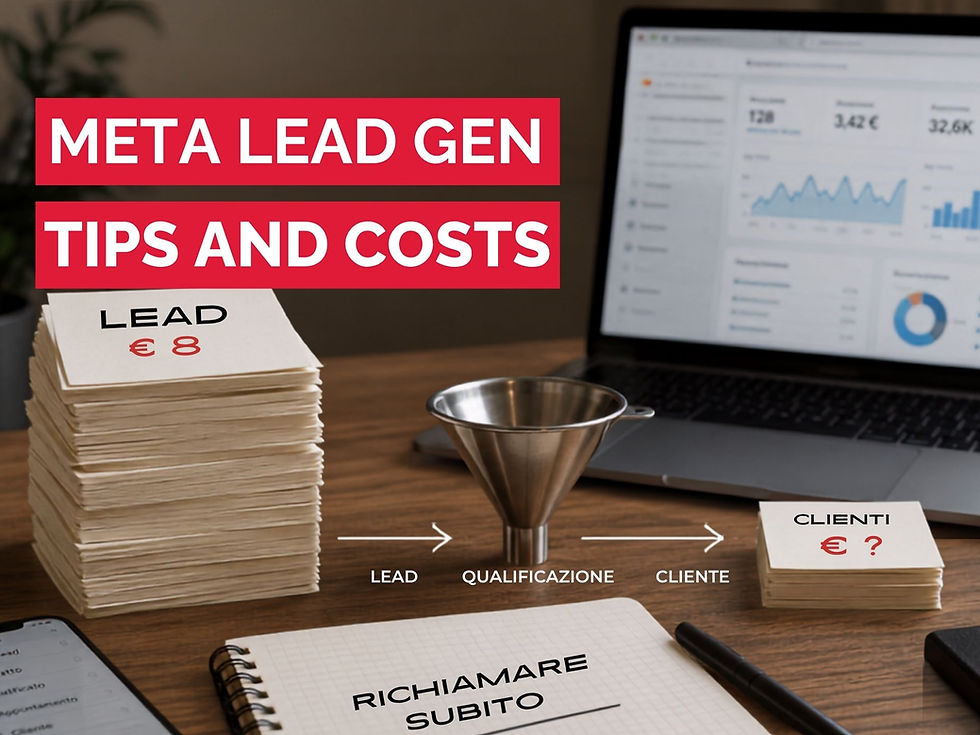
An €8 lead may seem great, but if no one answers the phone or if no one buys, its business value is close to zero .
Conversely, a €45 lead can be sustainable if the customer value acquired is high and the deal closing rate is good.
The important step is to distinguish between a generated lead, a qualified lead, an offer made, and an acquired customer.
A Meta campaign can be very good at generating the first step, but the financial result only comes when you connect that data to the rest of the sales process.
For this reason, in a serious campaign, the CPL should be read together with other indicators: callback time, percentage of leads contacted, percentage of appointments scheduled, estimates sent, contracts closed and average margin .
Without this data, you risk optimizing for the cheapest contact, not the most useful customer.
The real challenge: creating a strong enough offering
The hardest part of lead generation on Meta isn’t setting up the campaign.
The hard part is creating an offer that a person immediately understands and finds interesting enough to leave their information.
Many companies start with what they want to sell. They talk about the product, the technology, the quality, the experience, the certifications. These are all important things, but they often arrive too late in the user's mental journey.
On Meta, the user isn't actively searching. They're scrolling through a feed. To stop them, you need to start with a recognizable problem, not the company's technical specifications.
This may seem trivial, but in practice it is where many campaigns break down.
Companies tend to be self-referential , technical , cautious .
Instead, Meta rewards immediate, understandable messages built around a concrete problem: “Are you spending too much?”, “Do you have this problem?”, “Do you want to understand if you can access this incentive?”, “Do you need to choose without wasting time?”.
The best creativity is often not the most beautiful. It's the kind you understand in a second.
"Ugly" but Clear Creativity: Why It Often Works Better
In many high-performing campaigns, especially on internal modules, the creative isn't necessarily refined. Sometimes it's almost crude : large text, simple visuals, a clear promise, and an immediate benefit.
From an aesthetic point of view they may seem less elegant than institutional communication, but they work because they reduce the user's cognitive work .
This is also true in B2B. In fact, it's often even more important in B2B, because the common mistake is to think that professional audiences want complex messages.
In reality, even an entrepreneur, a purchasing manager, or a technical contact can decide in a few seconds whether a piece of content deserves attention.
That's why, when a campaign isn't working, it's often not about "making a better visual." It's about clarifying the problem you're solving.
Short videos, especially reels, can help a lot if they get straight to the point and are edited dynamically enough to hold attention.
They don't have to look like cinema. They need to be understandable, quick, and specific. The first second is often more important than the final logo.
When Meta Lead Ads Work Well
Meta Lead Ads work well when three conditions exist:
the offer is simple to understand
the public has a recognizable problem
the company is ready to call back quickly
It works well for lead magnets, webinars, catalogs, checklists, requests for information on incentives, local services, offers with a strong financial advantage, or initial consultations.
It can also work in B2B, especially when the message doesn't get lost in technicalities and when the company accepts that the lead is often at the beginning of the journey.
The internal form is particularly useful when the goal is to reduce friction and quickly generate interest . In this sense, it shouldn't be seen as a "sales form," but rather as an entry point. The real work begins later.
We've also written about how to choose the right lead type for your PPC strategy here: https://www.hangler.it/post/come-scegliere-il-giusto-tipo-di-lead-per-la-tua-strategia-di-ppc
When it doesn't work instead
Meta Lead Ads don't work well when the company expects the lead to be ready to buy. This is the main misconception .
A contact from Meta may be interested, but often needs to be worked on. If the sales rep calls back after two days, makes a cold and generic call, doesn't have a basic script, or treats the lead as if they've already made up their minds, the campaign is perceived as poor, even when the problem lies in the sales process .
It also works poorly when the offering is weak or confusing.
If the user doesn't understand why they should leave their data, the system can still generate leads, but they will be more random, less motivated, and more difficult to convert.
Finally, it works poorly when the company does not accept the nature of the channel.
Meta is not Google Search. On Google, the user searches for a solution. On Meta, you interrupt the user with a suggestion. This requires simpler messaging, more direct creativity, and faster follow-up.
The Follow-Up Problem: Call Back Right Away or Lose Value
One of the most underestimated factors is contact speed . A lead from an internal form must be contacted immediately, because interest arises quickly, often impulsively, and can quickly fade.
When the salesperson calls back late, several things happen: the lead no longer remembers the form, doesn't respond, has already evaluated alternatives, or simply has lost urgency.
At that point the campaign appears to have generated “poor” leads, but in reality the system has missed the moment.
In more sensitive projects, artificial intelligence can help with initial screening. A system like MioCalendario , for example, can quickly contact the lead, gather information, qualify their interest, and suggest an appointment or a next step.
This does not replace the commercial , but it prevents contacts from remaining stagnant.
The point isn't to automate everything. The point is to not let a hot lead go cold due to a lack of process.
Tracking, CRM, and Offline Conversions: A Leap in Quality
The most important part, in the coming months, will be less and less "generating leads" and more and more understanding which leads become customers.
Advertising platforms learn from the data they receive. If Meta only sees the completed form, it will optimize to generate more completed forms.
But not all modules are equal.
Some contacts don't respond, some aren't targeted, some receive an offer, and some become customers.
The quantum leap occurs when the CRM is connected to the advertising system and offline conversions are returned to the platform as personalized events.
This way, Meta can receive more useful signals: qualified lead, appointment scheduled, offer made, customer acquired.
At that point, the campaign no longer works just to find people willing to fill out a form, but can start optimizing towards people more similar to those who produce real value.
This topic is related to conversion tracking in lead generation, which we have explored in depth here: https://www.hangler.it/post/tracciamento-e-lead-generation
Datasets, API Conversions, and Server-Side: Why They Will Matter More and More
To make campaigns work better, the Meta dataset must be correctly connected to the site and conversion events.
The Conversions API, especially when managed server-side, allows you to send cleaner and more stable data to the platform, reducing dependence on cookies and browser limitations.
This will become increasingly important, as traditional tracking is becoming less reliable .
If the ad account receives little or dirty data, the algorithm has fewer sources to understand who to target.
And in a market where advertising costs are rising and attention is declining, the quality of the data will make a huge difference.
In practice, two companies can have the same offering and the same budget, but the one with better tracking and a connected CRM will have a progressive advantage: it will be able to teach the platform which leads are truly valuable.
We've written a dedicated article on server-side tracking: https://www.hangler.it/post/server-side-tracking
And on advanced tracking to understand which companies visit the site, especially in B2B contexts, there's this article: https://www.hangler.it/post/scopri-chi-visita-il-tuo-sito-web
What we learn from the data
From the data collected, one thing emerges quite clearly: Meta can generate leads in very different sectors, with sustainable costs even in B2B, but the range is wide.
Prices can range from less than €5 for a webinar or a very simple offer, up to over €60 in more competitive, complex sectors or where the decision has a higher economic value.
This means that there's no "good CPL" that works for everyone. There's a CPL that's consistent with margin, closing rate, and the quality of the sales process.
The most interesting data isn't the average cost. It's the variability . The same platform can produce very different results based on the message, offer, creative, timing, and tracking.
For this reason, when a campaign isn't working, you shouldn't start with the question "Does Meta work or not?"
You need to ask yourself if the offer is clear enough, if the creativity stems from a real problem, if the salesperson calls back promptly, if the leads are qualified, and if the platform receives enough data to improve.
In summary
Lead generation on Meta Ads can work very well, but it is not a customer vending machine.
It works when the offer is strong, the message is simple, the creativity is immediate and the sales process is ready to handle often lukewarm leads.
The internal module is useful because it reduces friction and lowers costs, but for this very reason it requires more attention in follow-up and qualification.
The real difference, increasingly, will be in the data.
Those who continue to optimize only for generated leads will risk paying for easy but not very useful contacts.
Those who connect CRM, offline conversions, Meta datasets, and server-side tracking will be able to teach the platform to look not only for those who fill out a form, but also for those who are most likely to become customers.
And that's where lead generation stops being a collection of contacts and becomes a measurable business system.


Comments